
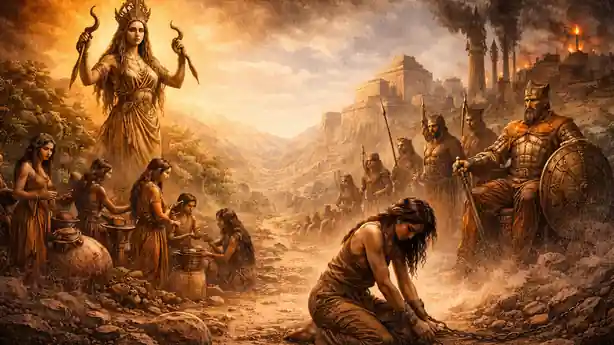
Woman as the First Colony of Civilization
The rupture from the woman-goddess culture to male-dominated power
Abstract
This article re-examines the founding dynamics of civilization through the axis of women’s freedom. While dominant narratives explain the origins of civilization through cities, surplus production, and state formation, this text foregrounds a deeper trajectory: the constitutive role of patriarchy (male domination). It analyzes—within the same historical process—the invisibilization of women’s labor, the weakening of society’s communal capacity as a “social nature,” and the normalization of power. The discussion argues that patriarchy is not merely a form of “gender inequality,” but a primary way through which state-based civilization penetrates social relations; capitalist modernity, in turn, intensifies this historical domination through commodification and industrial reproduction. The conclusion affirms that women’s freedom is not a secondary domain of rights but a constitutive principle for building a democratic society.
Keywords
Patriarchy; critique of civilization; women’s labor; commune; capitalist modernity; ethical-political society; free egalitarian life; democratic modernity.
1. Introduction
Explanations of the beginnings of civilization typically center “economic” and “institutional” factors: the emergence of surplus, the formation of classes, urbanization, and the institutionalization of the state. These accounts matter for understanding how power takes shape; yet an earlier and deeper mechanism that secures the continuity of power’s relationship with society is often pushed into the background: domination established through women. In this frame, the “woman question” is not only an issue of “equality” or “rights,” but a key field for understanding the mentality regime that produces hierarchical sociality and the ways state-based civilization infiltrates society.
The central claim of this article is as follows: patriarchy is not a “later addition” or a by-product of civilization; in many historical contexts, it is a proto-form of power that makes state-based civilization possible. This form endures by (i) capturing the world of meaning (the sacred, myth, tradition), (ii) embedding itself in institutional relations (family, property, inheritance), and (iii) becoming industrialized in the modern era through the instruments of capitalist modernity.
2. Conceptual framework: social nature, ethical-political society, and power
The concept of “social nature” emphasizes that society is not merely a set of institutions but a historically formed web of relations. The sustainability of this web depends on practices of care, sharing, production, solidarity, and collective decision-making. Because women’s historical role often lies at the nexus of these practices, rendering women’s labor invisible generates not only “economic exploitation” but also damages society’s ethical-political capacity.
In this context, patriarchy can be seen as a two-fold technique of power:
- Material dimension: control over labor and the body (domestic labor, reproduction, mobility).
- Symbolic dimension: production of legitimacy (myth, religion, tradition, “destiny,” “natural role”).
The transformation from “woman-goddess → male-god” is a critical pattern that demonstrates the symbolic dimension of power: power is established not only through force, but by organizing the world of meaning.
3. Discussion
3.1 The invisibility of women’s labor and the dissolution of communal life
Women’s withdrawal from the social sphere and the coding of their labor as “natural duty” advance alongside the weakening of communal life. The dissolution of the commune means the erosion of society’s self-governing practices; this erosion creates a ground of “governability” for state structures. Thus, the invisibility of women’s labor is not merely a domestic matter but a political dynamic of structural formation.
3.2 The family as a micro-model of power
Although the family can produce love and solidarity, under conditions of hierarchical society it can become a micro-model of power. Inheritance/property, honor regimes, role allocation, and the one-sided assignment of care work constrain women’s lives while normalizing male power. What is decisive here is not individual psychology but the institutionalized form of the relationship.
3.3 Capitalist modernity: the industrial reproduction of domination
Rather than overcoming patriarchy, capitalist modernity commodifies and disseminates it: women’s bodies become objects of consumption; women’s labor is precarized in wage markets while being reproduced as unpaid labor at home; care burdens concentrate on women. In this frame, the thesis “capitalism is not an economy but power” shows why the woman question cannot be reduced to the market: the issue is the reproduction of power through everyday relations.
4. Conclusion
Women’s freedom is both an analytical key for dissolving the mentality regime of state-based civilization and a constitutive principle for building a democratic society. Expanding rights matters; yet without transforming the mentality, relations, and institutions that reproduce patriarchy, durable liberation cannot be achieved. Therefore, the solution requires rebuilding communal life, ethical-political society, democratic modernity, and the ethic of a free egalitarian shared life on the foundation of women’s freedom.
Azad Badiki – kurdbe.com editorial team
20.02.2026