
Two Worlds Collide: A Democratic Solution Against Capitalist Modernity
DEMOCRATIC AUTONOMY – III
Abdullah ÖCALAN
9 – Capitalist Modernity and Democratic Modernity: Two Worlds, Two Lines
All tribal, clan, and kinship-based forms of rule allow for confederal relations of a loose kind. Otherwise, their internal autonomies are harmed, which would disperse their very existence. Even empires rely on countless different forms of administration in their internal structures. Tribal and clan authorities, religious authorities, monarchy—indeed, even republics and democracies—can unite within an imperial framework. In this sense, it is important to grasp that even the empires considered most centralized are, in a way, a form of confederalism. The drive toward centralization is not a model society needs, but a model monopoly needs.
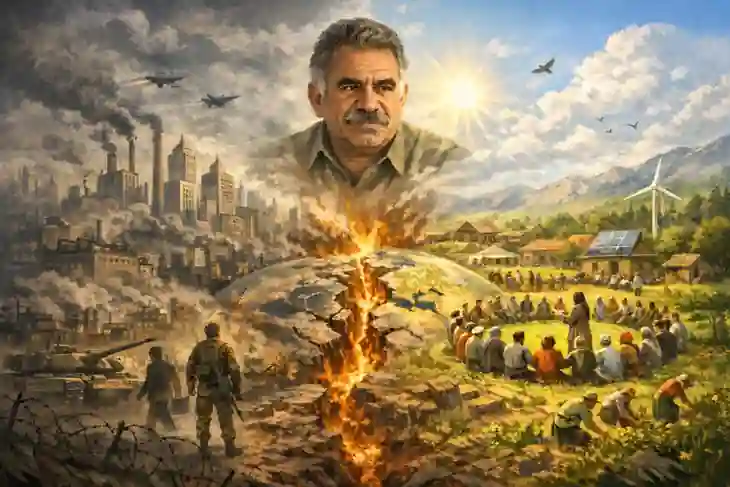
The differences and antagonisms between capitalist modernity and democratic modernity are not merely ideas; they are two vast worlds lived concretely. Throughout history, these two worlds have traveled with dialectical contradictions—sometimes fighting ruthlessly, yet never entirely without periods of peace. Today, too, they relate in similar ways: sometimes in conflict, sometimes in peace. The outcome will undoubtedly be determined by those who, intellectually, politically, and ethically, find a path toward what is true, good, and beautiful out of the current systemic structural crisis.
10 – My Solution Project Is Based on Democratic Autonomy: Six Dimensions and the Turkey/Middle East Framework
My solution project is based on democratic autonomy. While capitalist modernity comes into being through capitalism, industrialism, and nation-statism, I have tried to analyze and resolve how democratic modernity can come into being through democratic communality, an eco-industrial society, and a democratic nation.
I have defined democratic communality not as homogeneous egalitarianism, but as every kind of community—ranging in scale from one person to millions—that bears the quality of an ethical and political society: communities of women and men, sports and arts, industry, intellectuals and shepherds; tribes and companies; families and nations; villages and cities; local and global communities; from clans to global society.
I defined the eco-industrial social reality as eco-industrial communities in which village–agricultural society and urban–industrial society nourish one another and are definitively adapted to ecology. I defined the democratic nation, through democratic confederalist practices as a basic political form, as a new type of nation in which all cultural existences—from ethnicity to religion, from urban and local communities to regional and national communities—form democratic autonomous political structures; in other words, a multi-identity, multicultural, and multi-political nation against the nation-statist “monsters.”
In line with this historical reality, I can say the following about democratic autonomy: My solution project is based on democratic autonomy. On the one hand, my project is a solution that does not clash with borders within itself; on the other hand, it is a solution that rejects universal hegemony without necessarily entering into conflict with it—one that can sustain itself within what is also called the “empire” of global hegemony, without dissolving into it, on the condition that it preserves its principles. This solution also includes the principles of democratic confederalism. I said: political, social-cultural, economic, diplomatic, security, and legal. Democratic autonomy includes these six principles. Resolving this issue on the basis of democratic autonomy will illuminate the entire Middle East. It will also be a model for Italy and Spain. My views on the state and power run parallel to Gramsci’s. Marx accepted the nation-state; I do not. The fundamental reason for Europe’s current crisis is also this nation-state structure and mentality. Our projection and aim is to achieve this solution through peaceful means with the least damage.
We may explain democratic autonomy as follows: If the democratic nation is the spirit, democratic autonomy is the body. Democratic autonomy is the incarnation of democratic nation-building—its tangible, embodied form. Democratic autonomy has several dimensions:
- Political Dimension: There is a parliament, or a people’s congress— the democratic society congress. It also has a small executive committee.
- Legal Dimension: This expresses the legal status of the democratic autonomy project—let us call it “status.” The Catalans also call it “status.” This is very important. What will the Kurds’ legal status be? It is reflected in the constitution and laws. Laws define the content of democratic autonomy’s framework.
- Economic Dimension: The democratic nation being built has an economic policy: what kind of economy should it be? There is policy for dams and for underground/aboveground resources. If taxes are to be collected, how and how much? These are determined here. We cannot accept capitalism as the economic system. Perhaps we cannot abolish it completely at once, but we can change it significantly, erode it, and build our own system. In this system there is a people’s economy, and a part is a private economy—private companies. All of this must be discussed.
- Cultural Dimension: This includes language, education in the mother tongue, history, and art. How should Kurdish relate to Turkish? How can mother-tongue education be implemented? What will be the democratic nation’s language policy? An education policy must be formed. How can Kurds fully overcome cultural genocide? It must be overcome through debate and work in this field.
- Self-Defense Dimension: We can also call this the security dimension. Here we address genocide. How can Kurds be freed from genocide? This must be concretized. Genocide includes all types—not only physical, but cultural and every kind. Kurds should attain a condition of self-defense. Society builds its own self-defense. By this I do not mean only having weapons. Self-defense is not an armed structure like KCK or PKK; it is the people’s ability to ensure their own security. I mean the organization and institutionalization of democratic society in every field, and attaining its own security system. People can discuss this more and reach different conclusions: will they send their children to the army, will they take part in the military, how will village guards be abolished, how will that issue be resolved? These must be discussed. The people’s self-defense is as vital as bread, water, and air; without it, one cannot live. Some intellectuals interpret this as a search for a separate state; I am aware of that. This issue is misunderstood. I want to say: Will Kurds be in the existing military structure or not? In police and security institutions or not? What will these institutions’ view of Kurds be? How will Kurds protect themselves and guarantee security? These are very important issues, and I will address them in detail later. This security dimension cannot be done by BDP or PKK alone; I will carry it forward and elaborate later.
- Diplomacy Dimension: This concerns Kurds’ relations with other peoples and societies: relations with neighboring countries, with Kurds in other parts, and with other societies. What kind of relationship do we want, and how should we live together? This is covered here.
It could be extended further, but these six dimensions are sufficient as a framework. For each dimension, there will be multiple commissions and work.
Democratic autonomy and a democratic constitution are different things. The democratic constitution work across Turkey, and discussions with civil society organizations nationwide, is the duty of BDP. BDP must have an intensive work and a project regarding a democratic constitution. KCK and PKK will determine their own place within the democratic autonomy system. That is their business. Kurds—DTK, BDP—will discuss what kind of life they want and decide; they will discuss it day and night.
If the democratic nation is the spirit, democratic autonomy is the body.
Institutions of democratic autonomy are comprehensive. Deep debates can be held in cultural, economic, political, legal, security, and diplomatic fields. Academies can provide the ground for debate. The people can decide analyses and solutions in City Councils. As an example, in Diyarbakır, with intensive organization, certain unions can be formed: Democratic Tradespeople’s Union, Democratic Artists’ Union, Democratic Athletes’ Union, etc. Many such democratic unions can be formed; they find representation in City Councils. Democratic autonomy and democratic nation are like body and spirit; they complete each other and cannot be separated. Without a body there is no spirit; without a spirit there is no body. Without a democratic nation there is no democratic autonomy; without democratic autonomy there is no democratic nation.
Our democratic autonomy project is not based on ethnicity or geographic borders. There is no single-ethnicity or single-geography understanding in our conception. I addressed this in detail in my defense titled “Freedom Sociology.” Our understanding is not “Kurdism” alone; it is not based solely on Kurdishness, Turkishness, or Arabness. It is based on democracy. For example, democratic autonomy could also be established in Hatay or Adana; there, Arabs would express themselves predominantly. Our understanding is also not based on a single faith. It is based on peoples—though even saying “peoples” alone is insufficient; it is based on different social strata, classes, and segments. This democratic autonomy is not only for Kurdistan; it also relates to the Aegean, the Black Sea, and Central Anatolia. What matters is questioning and overcoming the nation-state understanding produced by capitalist modernity. Debates must develop on this basis. We are questioning the four-hundred-year nation-state experience created by capitalist modernity. We must see that the nation-state model is too narrow and insufficient for peoples, classes, strata, and social segments. Even Europe has begun to debate and overcome this. The nation-state-centered capitalist understanding must be overcome.
In Turkey, too, the existing nation-state understanding is not the solution; it is the source of the problem. This system is incompatible with the social reality of Turkey and the Middle East; it must be overcome. Turkey, as it is, cannot answer or satisfy any segment. This nation-state understanding has begun to be carved away from all sides; every segment is trying to chisel it from a corner. Perhaps the task for Kurds is to lead in these matters. We do not limit the democratic autonomy project to ourselves; we do not base it solely on Kurdish ethnicity. Kurds can lead today, but this is a project that encompasses all of Turkey. What must be seen is that Turkey cannot be governed through the nation-state understanding. Democratic autonomy is the most correct and applicable option against the nation-state—everywhere, in Turkey and the Middle East. What is essential in democratic autonomy governance is society’s will to govern. Society takes certain powers from the state and develops its own understanding of governance. The powers left in the hands of the state will be limited, specific powers. Society will govern itself with its own powers by limiting the central state. What matters is limiting the state. I call this transferring the center’s powers to society—not just “the people,” but society.
As I said, Kurds are not leading only in Turkey. This project is not limited to Turkey; it applies to Iraq and to the Middle East as well. It can be implemented and develop there. These developments nourish each other and develop in awareness of one another. I am not saying we will abolish the nation-state immediately. We are aware it may not be overcome right away. But we will not settle for the nation-state. Nor do we intend to administer the nation-state.
In Turkey there is also an attempt to build a single nation. The nation identity intended in the Republic’s history is Turkishness. I once called this a “non-Turk Turkist ideology.” Let there be no misunderstanding: I am not engaging in anti-Semitism. But as a historical reality, I must say that Jews played a role in this “non-Turk Turkist ideology.” I had previously called this “Anatolian Zionism.” By developing this Turkist ideology, Jews built the nation-state in Turkey. This ideology is at the foundation of Turkey’s nation-state.
This fascist-Turkist understanding, as you know, finds expression in the Committee of Union and Progress as well. In the name of building a nation, all different languages and cultures, identities and beliefs were attempted to be homogenized. This Union and Progress fascism even fathered the ideas of Hitler’s fascism and encouraged it. When we speak of democratic autonomy, we highlight this historical injustice: the injustice of “you were there in the founding of the Republic, but you are not included within it.” The declaration of democratic autonomy should also offer a critique of the Republic’s history. It could even be conveyed in my name: the declaration of democratic autonomy should be an updating of 1919–1922. You know that in those years Mustafa Kemal attended the Erzurum Congress as the Bitlis delegate, i.e., as a Kurdish delegate, replacing the Bitlis delegate who could not attend. We want this history to be updated. There are historical roots of democratic autonomy in those years; and the break in 1925—the provocation, the conspiracy, the deterioration of relations—must be well understood.
With democratic autonomy, Kurds gain their right to be a nation, their historical rights; and other identities also gain their democratic and minority rights. Due to their social, political, and cultural position, Kurds are the segment most predisposed to democratic autonomy. With this characteristic, Kurds can lead democratic autonomy and Turkey’s democratization. Kurdish democratic autonomy spreads step by step across all of Turkey. It is not only a Kurdish project; this is precisely what Başbuğ fears and sees as a danger.
If the solution does not develop, a dual power situation emerges in Kurdistan: on one side KCK power, on the other state power. It proceeds in this way. Then it declares independence like Kosovo, Northern Cyprus, etc. It completely severs relations with the state and does not wait in expectation. There is no hostility to the state in democratic autonomy. From security to sports, Kurds should develop their social organization without needing the state. They should realize their social, economic, and cultural organizations. Kurds must ensure their internal security. For this, they should not wait for the state to accept them.