
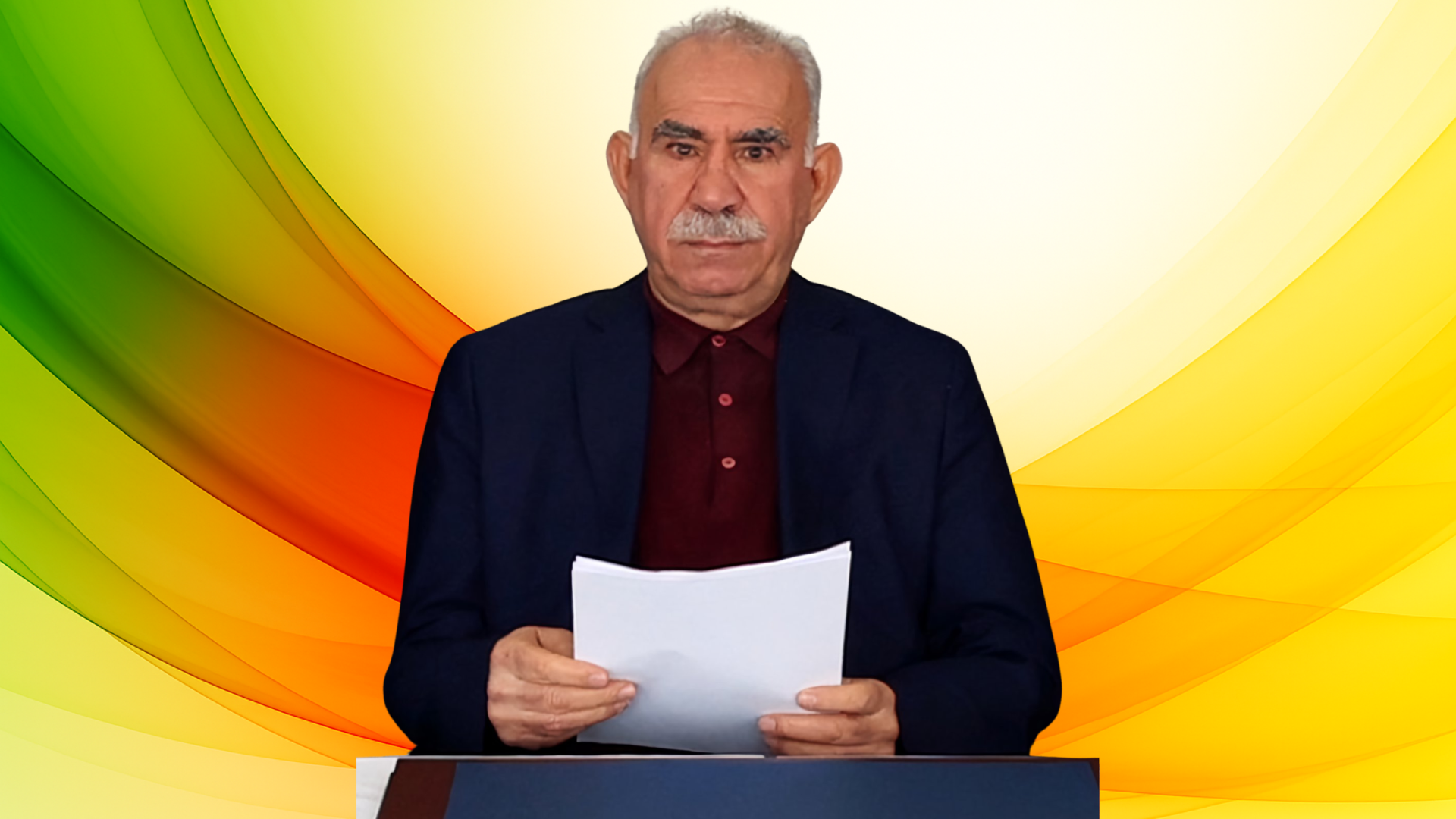
The latest effort to resolve Turkey's Kurdish question — a conflict that has persisted for more than forty years and cost tens of thousands of lives — is approaching a critical legal threshold. Kurdish People's Leader Abdullah Öcalan, held in the İmralı Island prison since 1999, has presented a comprehensive package of proposals to place the process on a legal footing.
The details emerged through statements by Mithat Sancar, a member of the pro-Kurdish DEM Party delegation that visits Mr. Öcalan at regular intervals. The delegation met him on 24 May; the roughly two months that had passed and renewed talk of the process having "stalled" lent the meeting particular significance.
"The train hasn't derailed"
Sancar sums up the state of the process with a train metaphor: what matters most is that the train stays on the rails; the speed may drop at times, the train may even pause for a while, but the essential thing is that it has not left the tracks. The slowdown of recent months, he says, should be read in this light — and the train is now moving again.
In the background lies the steps taken by the PKK leadership on 27 February in response to Mr. Öcalan's call. Following that call, the organisation made moves toward laying down arms, and a parliamentary commission was set up in Turkey to address the issue. What is now under discussion is the legislation that would make this political opening permanent.
Öcalan's three headings
According to Sancar, the roadmap presented by Mr. Öcalan consists of three main headings.
The first is the nature of the law to be enacted. Mr. Öcalan describes it with a striking metaphor: the law should be "like a stem cell." Invoking the two functions of a stem cell — repair and renewal — he argues the legislation should both open the way to repairing the damage caused by the conflict and clear a path for the renewal of the social body. Sancar defines this as the dialectic of a "transition from violence to politics": moving the issue out of the arena of arms and conflict and onto the ground of law and politics. What is meant is not a permanent statute but a framework law governing the transition period, expected to cover matters such as the laying down of arms and the reintegration of former fighters into society.
The second is the institutionalisation of the process. At present the process largely runs through scattered meetings: the DEM Party delegation travels to İmralı and makes contact with state officials and other parties; Mr. Öcalan himself meets with state officials. The proposal is to tie all this activity to institutional mechanisms with defined duties and responsibilities — various boards, for example — so that the process can advance on a more reliable and durable footing.
The third is the definition of Mr. Öcalan's own role. He wants his position, function and powers in the process to be clarified through the law to be enacted. Sancar stresses that content matters more than any "naming" here, saying the definition should be made "in keeping with the logic of the process."
An emphasis on urgency, and a deadline
The point Mr. Öcalan's message underlines is urgency. As relayed by Sancar, Mr. Öcalan says, "Remaining in a state of expectation only produces risk; we have no time to lose," and sets the goal of passing the legislation before parliament breaks for the summer recess.
One reason for the urgency is regional instability. According to Sancar, Mr. Öcalan says that although the conflict along the US-Iran-Israel axis appears to have stopped, the underlying tensions persist, the Middle East remains open to fresh conflict, and this poses a risk to the process.
No concrete draft yet
Claims have circulated publicly that the governing AKP and MHP and the DEM Party had agreed on a draft law, and that the text had been approved by Mr. Öcalan. Sancar flatly denies this: what is being done at this stage is an exchange of views and negotiation; no concrete draft text has reached them. Interpretations along the lines of "everything is ready and will be served up later," he says, are speculation and could create risks for the process.
A shadow: the court ruling against the CHP
Sancar also touches on a development that could cast a shadow over the course of the process: the "absolute nullity" court ruling targeting the main opposition CHP, which amounts to an intervention against elected officials. (This is a legal process that led to a party congress being annulled and the party's leadership being opened to dispute.) Speaking as a jurist, Sancar describes the ruling as "entirely without legal basis" and a grave example of the tradition of "designing politics through the courts." He relays that Mr. Öcalan, too, finds the situation "unacceptable," having said that "the point now reached is a result of the absence of the principle of democracy at the foundation of the republic." Sancar stresses that the CHP should remain one of the main actors in the process.
"What is essential is social force"
Sancar closes by arguing that the process cannot be left to the actors at the table alone. He says the conflict of more than forty years — an issue whose roots reach back a century — has produced hardened, opposing memories on every side, and that progress is possible only by softening that rigidity. In his view, peace and democracy do not come through "top-down arrangements" alone; what is decisive is social dynamics, and everyone should see themselves as responsible for the process.